The Real Cost of Buying Property in Spain
What International Buyers Often Underestimate
For many international buyers, one of the biggest surprises about purchasing property in Spain is discovering that the listing price is rarely the final price.
Buying a home may ultimately require substantially more capital once taxes, legal expenses, financing costs, renovation work and ongoing ownership costs are taken into account. For buyers unfamiliar with the Spanish system, these additional expenses can quickly become overwhelming.
The issue is not simply that these costs exist. The issue is that they are often fragmented across different professionals and stages of the transaction. The real estate agent focuses on the property itself, the bank discusses financing, the lawyer handles legal matters and the gestor manages paperwork and taxes. Yet very few buyers receive one complete overview of the true acquisition cost before committing to a purchase.
This is why understanding the full financial picture before making an offer is essential.
As a general rule, international buyers should expect to budget approximately 10% to 15% above the purchase price for taxes and transaction costs alone. If the property requires renovation or furnishing, the total investment can easily rise 20% to 30% above the original asking price.
Property Purchase Taxes in Spain
The largest upfront expense when buying property in Spain is usually the purchase tax.
For resale properties, buyers must pay Property Transfer Tax, known in Spanish as Impuesto de Transmisiones Patrimoniales (ITP). The applicable rate depends on the autonomous community where the property is located and, in some cases, the value of the property or the buyer’s circumstances.
In most regions, general ITP rates range between 6% and 11% of the purchase price.
General ITP Rates by Area
Autonomous Community | General ITP Rate |
|---|---|
Valencian Community (Valencia, Alicante and Castellón) | 9%-11%* |
Andalusia | 7% |
Aragón | 8% |
Asturias | 8% |
Balearic Islands | 8%-13% |
Canary Islands | 6.5% |
Cantabria | 9% |
Castile-La Mancha | 9% |
Castile and León | 8% |
Catalonia | 10-13% |
Ceuta | 6% |
Community of Madrid | 6% |
Extremadura | 8%-11% |
Galicia | 8% |
LaRioja | 7% |
Melilla | 6% |
Region of Murcia | 8% |
Navarre | 6% |
Basque Country | 4%-7% |
*The Valencian Community (Valencia, Alicante and Castellón) charges an 11% ITP tax for properties over 1.000.000€
Note: Tax rates may vary depending on the property value, buyer profile and regional tax incentives. Some autonomous communities apply progressive tax brackets or reduced rates for specific cases.
ITP must generally be paid within 30 working days after the completion of the purchase.
VAT and AJD for New-Build Properties
The tax structure changes when purchasing a new-build property directly from a developer.
Instead of ITP, buyers must pay:
• 10% VAT (IVA in Spanish)
• AJD (Documented Legal Acts Tax)
VAT is paid directly to the developer as part of the transaction.
AJD, known in Spanish as Actos Jurídicos Documentados, is a regional tax applied to certain notarised legal documents, including many new-build property purchases and mortgage deeds.
Depending on the autonomous community, AJD generally ranges between 0.5% and 1.5% of the purchase price or mortgage liability.
For many international buyers, this is one of the most commonly overlooked costs when comparing resale and new-build properties.
Real Estate Agency Fees
Another important expense may be real estate agency fees.
In Spain, fee structures vary significantly depending on the region, agency and type of transaction. In some cases, the seller pays the agency commission. In others, buyers may also be charged advisory or brokerage fees.
Buyer-side real estate fees can sometimes reach 2% to 2.5% of the purchase price plus VAT.
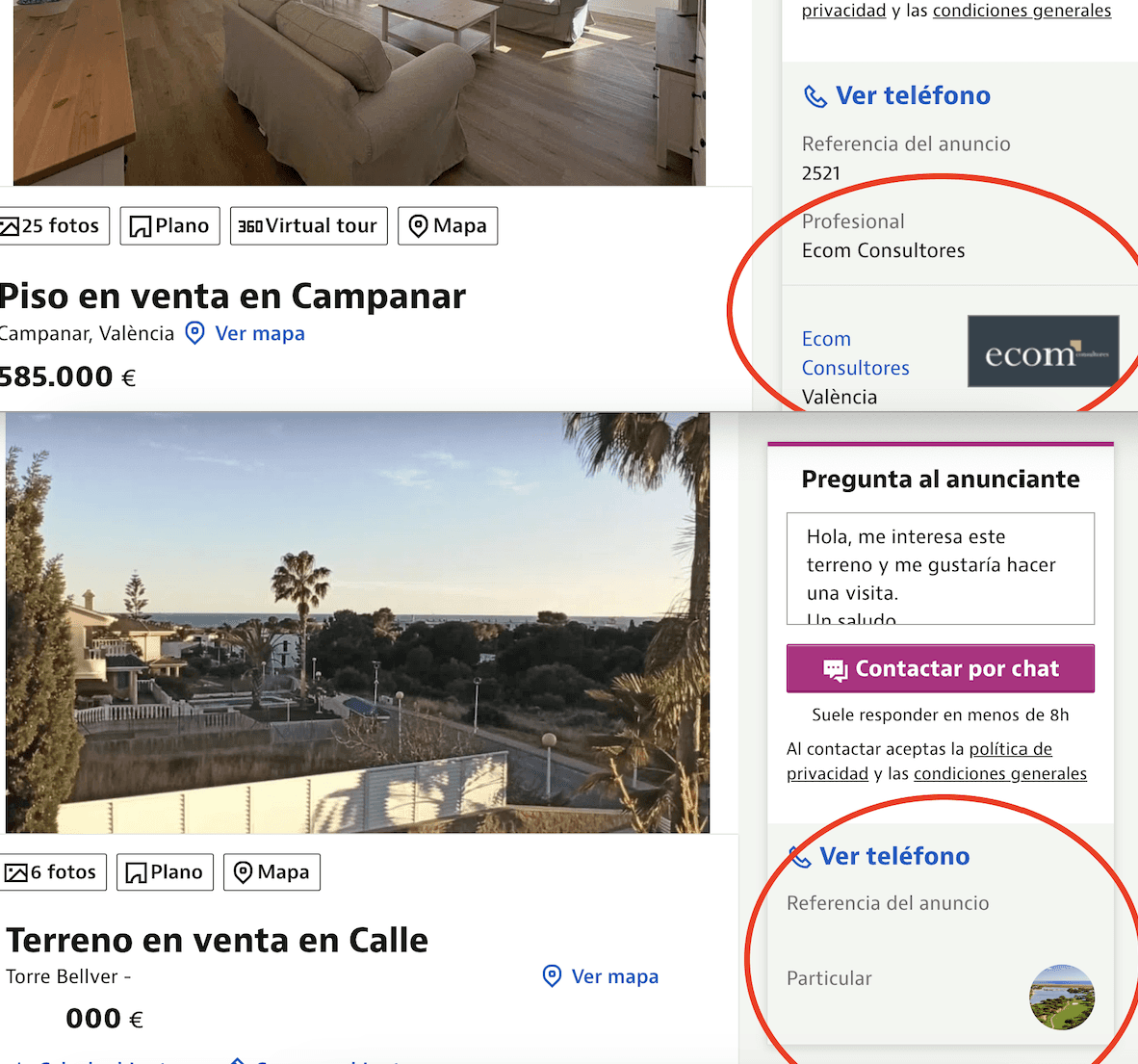
Not all transactions involve agency fees. Some properties are sold directly between private individuals, particularly on portals such as Idealista. As shown in the image below listings posted by agencies are usually labelled as “Profesional”, while owner-listed properties are commonly identified as “Particular”.
However, even when a buyer does not directly pay an agency fee, the commission structure may still influence the negotiation process and property pricing.
For international buyers unfamiliar with the Spanish market, understanding who represents whom is especially important.
Notary and Land Registry Fees
All property purchases in Spain must be formalised before a public notary.
Notary fees are regulated by the government and typically range between 0.3% and 0.5% of the purchase price, depending on the complexity of the transaction.
Once the deed is signed, the purchase must also be registered at the Land Registry.
Land Registry fees usually represent approximately 0.1% to 0.25% of the property value.
These expenses are commonly coordinated by the buyer’s lawyer, notary office or gestor as part of the legal completion process.
Mortgage Costs in Spain
Buyers financing their purchase with a Spanish mortgage should also consider financing-related costs.
Depending on the bank and mortgage structure, mortgage arrangement fees may range between 0.5% and 2% of the mortgage amount.
Before approving financing, banks will usually require an official property valuation carried out by a certified valuation company. This is commonly referred to as an ECO valuation and typically costs around €400.
International buyers should also keep in mind that Spanish mortgage approval processes can differ substantially from those in countries such as the United States or the United Kingdom.
Requirements for non-residents may include:
• Proof of foreign income
• Tax returns
• Bank statements
• Existing debt declarations
• NIE number
• Additional financial documentation
Mortgage conditions can also vary significantly between banks.
Renovation Costs in Spain
For buyers purchasing older properties, renovation costs can become one of the most significant parts of the overall investment.
Full renovations in Spain generally range between €500 and €750 per square metre for standard finishes, while higher-end projects can exceed €1,000 per square metre.
A comprehensive renovation may include:
• Demolition of internal walls
• New layout distribution
• Full electrical installation
• Complete plumbing replacement
• Flooring and tiling
• Painting
• Interior carpentry
• Fitted kitchen installation
• Fully renovated bathrooms
It is also important to understand that many apartments in historic areas of Spanish cities may still have ageing electrical systems, outdated plumbing or exterior carpentry that requires replacement over time. A property located in an attractive neighbourhood does not necessarily mean that the building itself has been modernised.
Buyers should always verify:
• The year of construction
• The condition of electrical and plumbing systems
• Façade renovation history
• Roof condition
• Lift installations
• Building maintenance records
Renovation timelines in Spain can also be longer than many international buyers expect. Skilled labour shortages, permit delays and contractor availability often extend project durations beyond the original schedule. For this reason, renovation budgets should always include contingency margins.
Furnishing Costs
After renovation, furnishing becomes another major expense.
For a mid-range 100m² apartment, furnishing costs can easily range between €15,000 and €20,000 depending on the quality of materials, appliances and interior design choices.
For buyers working with more moderate furnishing budgets, brands such as SKLUM or Maisons du Monde are often popular choices due to their balance between design, affordability and practicality.
Planning to buy in Valencia, Alicante or Castellón?
We help international buyers understand the full purchase process before committing.
Property Ownership Ongoing Costs
Beyond acquisition costs, buyers should also budget for ongoing ownership expenses.
Community Fees and Building Expenses
One of the most misunderstood aspects of property ownership in Spain is the system of community fees.
Many apartment buildings and residential developments include shared facilities and common areas maintained collectively by property owners.
Monthly community fees may contribute to:
• Garden maintenance
• Swimming pool maintenance
• Elevator servicing
• Underground garage upkeep
• Cleaning services
• Security systems
• Concierge services
• Shared lighting and utilities
Community fees may be relatively modest in simple apartment buildings but considerably higher in developments with extensive amenities.
In addition to regular monthly fees, owners may also be required to pay extraordinary community charges, known in Spain as derramas. These are additional payments requested to finance major building works such as façade renovations, structural repairs, lift modernization etc.
Before purchasing, buyers should always request documentation from the building’s administrador de fincas (property manager) confirming there are no existing debts linked to the property, requesting to be informed of planned future works before purchasing.
Failing to verify this information can expose buyers to substantial unexpected expenses shortly after completion.
IBI Property Tax
IBI (Impuesto sobre Bienes Inmuebles) is Spain’s annual municipal property tax.
Depending on the municipality and property type, annual IBI costs may range between €360 and €900 or more.
Buyers can usually request previous IBI receipts from the current owner to estimate future annual costs.
Waste Management Fees
Most municipalities also charge annual waste collection fees.These costs vary depending on the location and size of the property but are commonly around €150 per year.
Utilities
Typical monthly utility costs may include:
• Electricity: €85
• Gas: €115
• Water: €30
• Internet: €30
This represents approximately €260 per month in recurring utility expenses.
Home Insurance
Basic home insurance policies may cost around €200 to €300 annually depending on the property and level of coverage. Insurance companies may also require periodic inspections for certain systems such as water installations.
Example: The Real Cost of Buying a Property in Valencia
Let’s assume you are purchasing a three-bedroom resale apartment in Valencia for €500,000.The property requires significant renovation work and you are financing 60% of the purchase price through a mortgage.
Purchase and Renovation Costs
Expense | Cost |
|---|---|
Transfer Tax (ITP) | 50,000€ |
Real estate agency fees | 15,125€ |
VAT / AJD | 0€ |
Notary fees | 2,000€ |
Land Registry fees | 1,000€ |
Mortgage commission | 3,000€ |
Property valuation | 400€ |
Total purchase taxes & fees | 71,525€ |
Renovation works | 50,000€ |
Furnishing | 15,000€ |
Total additional costs | 136,000€ |
Annual Ownership Costs (excluding mortgage)
Expense | Annual Cost |
|---|---|
Utility bills | 3,120€ |
Community fees | 1,000€ |
Savings for future building repairs | 1,000€ |
IBI property tax | 450€ |
Insurance | 260€ |
Waste management fees | 150€ |
Total annual costs | 5,989€ |
Estimated monthly ownership costs: approximately €498 per month (excluding mortgage payments).
Final Thoughts
This example illustrates why budgeting properly before purchasing property in Spain is so important.
Although the apartment was originally advertised for €500,000, after taxes, transaction costs, renovation works and furnishing ultimately reached the total capital required €636,525.
In other words, the real investment exceeded the original purchase price by more than 27%.
For international buyers, understanding these numbers before committing to a property can make the difference between a well-planned purchase and a financially stressful experience.
At ECOM Consultores Buyers, we help international buyers understand the full acquisition cost before making an offer. This includes taxes, legal expenses, financing assumptions, renovation estimates, building-related risks and ongoing ownership costs.
If you are planning to buy property in Valencia, Castellón or Alicante and want a clearer understanding of your real budget before purchasing, our team can help guide you through the process.

Written by: Enrique Boldó Sorribes

Related Articles